

China Powder Network News Recently, the rise in oil prices has become the hottest topic. Two days before the rise in oil prices, many citizens came to the gas station to fill up a tank of fuel, and some gas stations even had a "long queue" phenomenon. Why is oil so expensive?
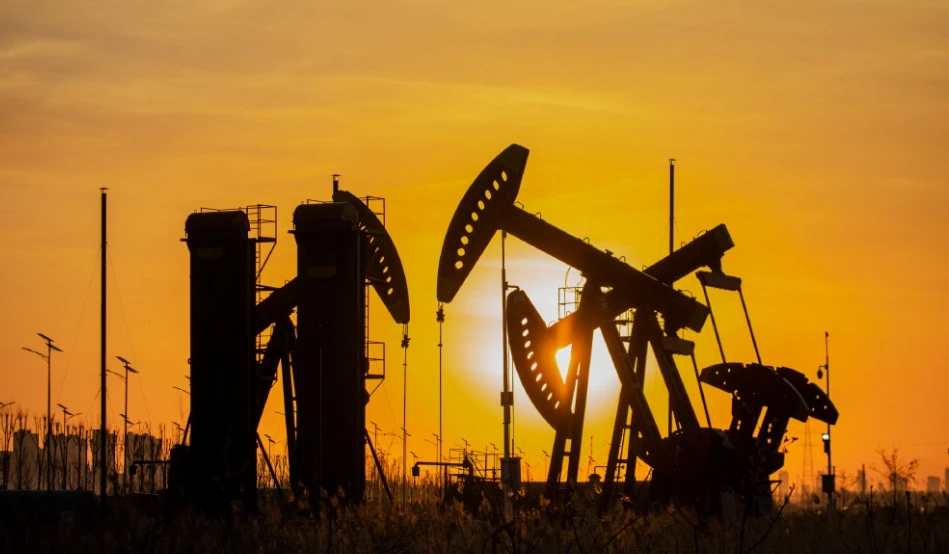
Image source: Sinopec Shengli Oilfield
There are many factors that affect the rise of oil prices, such as the new crown epidemic, the Russian-Ukrainian war, the world economic situation... But the most fundamental reason is that oil is a precious non-renewable resource, use a little less. As we all know, gasoline is extracted from oil, and global oil resources are scarce. To achieve sustainable development of oil resources, more efforts must be made in oil extraction. Oil proppant is a key factor in improving oil production capacity.
1 What is a petroleum proppant
Due to the poor physical properties and low permeability of some formations and reservoirs, hydraulic fracturing has to be used in oilfield development. Hydraulic fracturing is to inject fracturing fluid into the well by using the high-pressure pump set on the ground to generate huge pressure at the bottom of the well to form fractures. Sand-filled fractures with a certain geometric shape and size are formed, the oil and gas channels are smooth, and the oil and gas outflow area is increased accordingly. Therefore, in the fracturing process, proppant is a key factor to increase productivity, which can effectively introduce oil and gas into oil and gas wells, greatly improve the conductivity and maintain a certain level.
2 Performance requirements of petroleum proppant
① The proppant must have sufficient compressive strength and wear resistance, can withstand strong pressure and friction during injection, and effectively support artificial fractures.
② The relative density of proppant particles should be low, which is convenient for pumping downhole.
③ The proppant particles do not chemically interact with the fracturing fluid and reservoir fluid at a temperature of 200 °C, and the maximum allowable value of acid solubility should be less than 7%.
3 Current oil proppant types
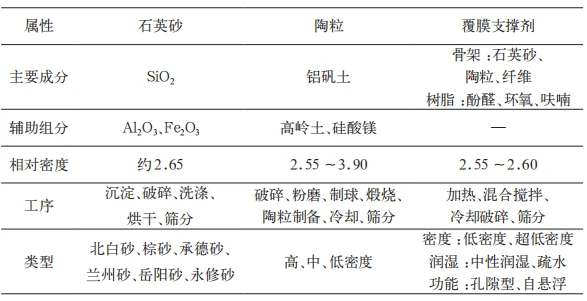
The proppant is natural sand or artificial high-strength ceramic solid particles with certain particle size and strength, certain sphericity and gradation. According to the actual application of proppants, proppants can be divided into 3 categories - quartz sand proppants, artificial ceramsite proppants and film-coated proppants. The performance characteristics of petroleum proppants of different materials are shown in the following table.
3.1 Quartz sand proppant
Natural quartz sand is suitable for the production environment where the oil well is shallow and the closed pressure layer is low. In the 1940s, natural quartz sand was mainly used as a proppant for fracturing oil and gas wells above 1500 m in oil production. Quartz sand was very popular in the market at that time because of its good performance, wide range of particle size grades, abundant resources and low cost.
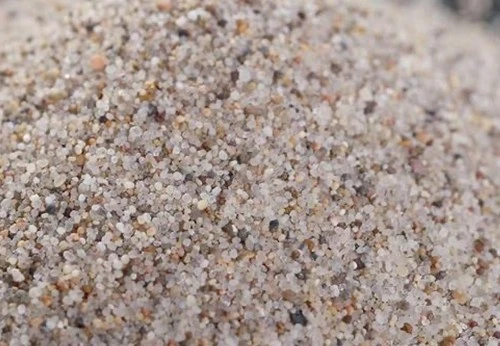
With the increase of mining depth and oil well pressure, quartz sand gradually cannot meet the mining requirements. Quartz sand is brittle and low in strength. When the fracture closure pressure is high, quartz sand is easily broken, which significantly reduces the effective support area of fractures and cannot achieve the effect of oil and gas stimulation. The surface of quartz sand is not good, which is not conducive to increasing fracture penetration. Rate. In addition, the thermal expansion coefficient of quartz sand is large. When the well depth is deep and the temperature is high, the quartz sand has the risk of sudden expansion due to phase change.
3.2 Ceramsite proppant
The raw materials of ceramsite proppant are generally aluminum-containing minerals, industrial wastes, and some auxiliary ingredients. After specific processing, a proppant that meets standards such as high temperature resistance, high pressure resistance, and low density is formed.
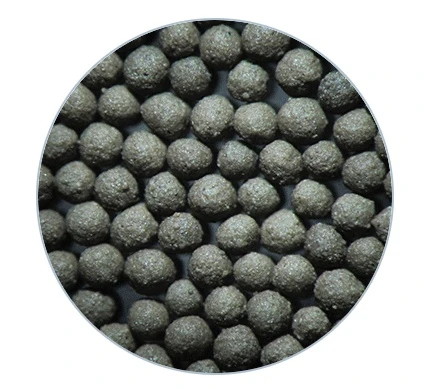
Image source: Wanli Industrial Development Co., Ltd.
Compared with the quartz sand proppant, the ceramsite proppant has better properties such as hardness, sphericity, and corrosion resistance, but the relative density of the ceramsite proppant is higher, and the phenomenon of back-feeding will occur, which has a negative impact on the viscosity and flow of the fracturing fluid. Transgender has higher requirements. Therefore, ceramsite proppant is widely used in the fracturing and exploitation of deep and low permeability oil and gas reservoirs.
3.3 Coated proppant
The film-coated proppant refers to a proppant that wraps a layer of curable organic matter in the outer layer with ceramsite sand as the core, which improves the strength and acid and alkali resistance of the proppant. It is also called resin-coated proppant.
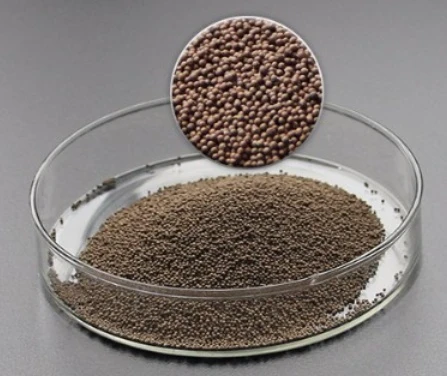
Image source: Wanli Industrial Development Co., Ltd.
Resin-coated sand proppant can meet the mining needs of deep closed high-pressure environment, and its strength and corrosion resistance can meet the standards. Compared with ceramsite proppant, resin-coated proppant has a lower relative density and is easier to pump. The encapsulated resin layer has greater conductivity than uncoated ceramsite proppant, and has stronger corrosion resistance.
However, the resin-coated proppant also has the following problems: the raw material cost and process cost are higher than those of the ceramsite proppant, and the economy is not strong; the chemical stability of the outer resin film is not strong; under high closing pressure, there may be sticking phenomenon. , thereby affecting the diversion capacity.
4 Status and development trend of petroleum proppant materials
In recent years, with the increase in the scale of mining, the sales of proppants are also increasing. Although the strength of quartz sand is not large, the cost is low and the resources are extensive. In most shallow wells, quartz sand can reach the standard of proppant. The cost of ceramsite proppant is relatively small, the preparation process is simple, and its hardness and acid resistance are better than natural quartz sand. cost to ensure a higher standard of mining quality. Resin-coated proppant solves the problems of ceramsite proppant's high density and back-spitting phenomenon, and its corrosion resistance is greatly enhanced, and its hardness can also meet the requirements. It can also be used in deeper wells. Fracturing agent.
The use of industrial waste to prepare petroleum proppant has low cost and strong economy, and the product performance can also reach the standard. This method can realize waste utilization and turn waste into treasure, which can become a new direction for future research and preparation of oil fracturing proppant.
Reference source:
[1] Bao He. Action mechanism and development prospect of oil fracturing proppant. Chemical Engineer. 2019.
[2] Middle East Petroleum Think Tank "Quartz sand is the preferred proppant for fracturing in the future! Is it really suitable to replace ceramsite? 》
【3】Song Pan, et al. Research progress of oil fracturing proppant. Petroleum and petrochemical green and low carbon. 2021.
[4] Leng Yueshan. Analysis of the development and application prospects of oil fracturing proppant materials. New material industry. 2018.
(Edited by China Powder Network/Xingyao)
Note: The pictures are not for commercial use, please inform and delete if there is any infringement!